
ChatGPT Can Write Your Travel Itinerary. It Can't Book Your Flight.
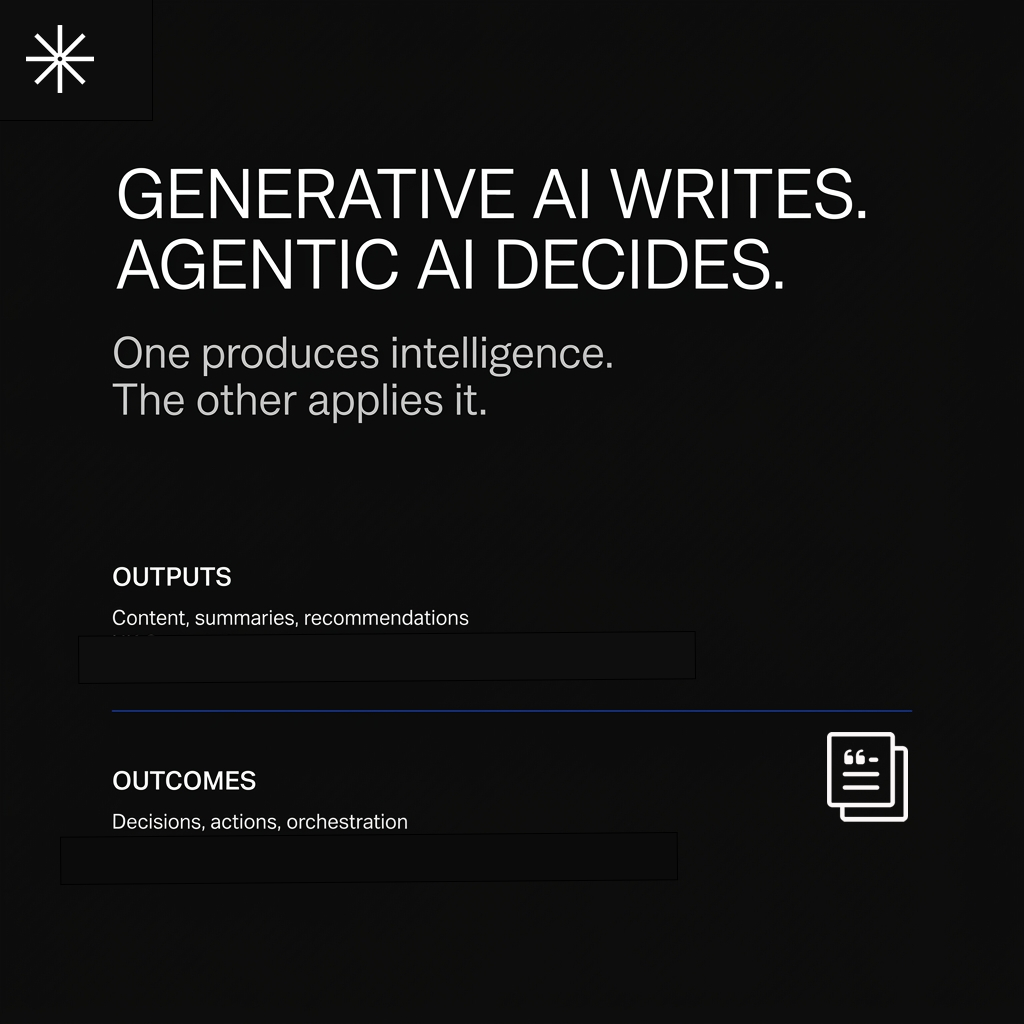
I've watched organizations spend six months building what they think is agentic AI when they've given a chatbot access to a few APIs.
TL;DR: Generative AI writes things. Agentic AI does things. The difference is operational. Generative systems produce outputs like itineraries and reports. Agentic systems pursue goals, make decisions, and execute actions across systems. Most organizations fund AI interfaces before fixing the orchestration, data flows, and decision structures underneath. The winners build foundations first.
Generative AI creates content. It drafts, summarizes, and generates recommendations when prompted.
Agentic AI executes workflows. It pursues objectives, interacts with systems, makes decisions, and adapts based on results.
Same models, different architecture. Both use large language models. Agentic AI wraps them in tool use, memory, state management, and workflow logic.
Enterprise integration is the bottleneck. About 95% of AI pilots stall because organizations skip orchestration, governance, and workflow alignment.
The market is shifting toward action. Google, Microsoft, and Salesforce move from chatbots to agents that automate multi-step workflows and execute inside business systems.
The confusion is understandable. Both systems use large language models. Both sound intelligent. Both get labeled AI in the budget request. The difference between generative AI and agentic AI is the difference between a system that produces intelligence and one that applies it.
That gap matters more in 2026 than two years ago. Not because the technology changed overnight. Enterprise-grade agent frameworks, improved model reliability, and regulatory clarity have moved agentic AI from experimentation to operational reality. The agentic AI age is here. We have agents deployed at scale performing tasks that generative systems only describe.
The travel planning example exposes the limitation.
What Is Generative AI?
ChatGPT writes you a perfect itinerary. It recommends flights, suggests hotels, maps out daily activities, and adjusts tone based on whether you're traveling for business or leisure. The output is polished, helpful, and often better than what you'd draft yourself.
But it stops at generation. It doesn't monitor prices across platforms. It doesn't check real-time availability. It doesn't handle checkout across multiple booking systems. It doesn't coordinate delivery of confirmations or adjust reservations when your inbound flight gets delayed.
That requires a different architecture. Agentic AI independently searches for flights, compares prices, adjusts the itinerary based on preferences, and makes the bookings without needing you to micromanage each step. It pursues a goal. It decides. It acts.
The Bottom Line: The distinction is not academic. It's operational.
How Generative AI and Agentic AI Differ
Generative AI helps you create faster. It drafts, summarizes, rewrites, translates, and generates recommendations. It's excellent at producing an output when prompted. The value shows up in content operations, knowledge retrieval, creative acceleration, and synthesis work.
Agentic AI helps you decide and do. It pursues objectives, reasons across steps, interacts with systems, makes bounded decisions, triggers actions, and adapts based on what happens next. The value shows up in workflow movement, decision velocity, and orchestration across disconnected systems.
One gives you outputs. The other drives outcomes.
The Bottom Line: Organizations buying AI for content generation often discover their real bottleneck is decision-making, orchestration, and execution across the enterprise.
Why Both Use the Same Models But Deliver Different Results
Both generative and agentic AI use large language models as their foundation. That similarity creates confusion. People assume same engine equals same capability. It doesn't.
The model is similar. The role it plays in the system is completely different. In generative AI, the LLM is the main event. In agentic AI, the LLM is part of a control loop.
With generative AI, the model interprets a prompt and generates an output. You ask, it responds. Even when there's retrieval or memory around it, the core pattern is centered on generation.
With agentic AI, the model functions more like a reasoning and coordination layer inside a broader system. It interprets goals, decides next steps, chooses tools, calls systems, evaluates outcomes, and determines whether to continue, stop, escalate, or retry.
Generative AI uses the model to produce a response. Agentic AI uses the model to manage a sequence.
The agentic capability doesn't come from the LLM alone. It comes from the system wrapped around it: tool use, memory, state management, workflow logic, governance, escalation rules, access to enterprise systems, and feedback from results.
The Bottom Line: Without those things, you don't have an agentic system. You have a very articulate model.
Where Generative and Agentic AI Sit Today
Content creation workflows using generative AI are real, deployed, and delivering value. The challenge is no longer does it work. The challenge is how do we operationalize it well, govern it properly, and connect it to real workflows instead of isolated prompts.
Shopping agents sit in a different maturity zone. They're real. The market is earlier, more fragmented, and less normalized at scale. What exists today is a mix of advanced AI assistants embedded into commerce journeys, guided selling systems becoming more conversational, and agent-like layers that compare, configure, or navigate.
Airlines like Emirates and KLM use AI agents in their chat systems to help passengers book flights, select seats, and receive boarding passes. Marriott and Hilton have integrated AI into their booking systems, allowing guests to book, modify, or cancel reservations through mobile apps or voice assistants. These aren't demos. They're production systems executing transactions.
Booking.com is moving further. The company is building what it describes as a concierge-like companion that follows you through the entire travel journey. Rebooking your flight if it's canceled, finding a new hotel if you're delayed, and suggesting restaurants nearby when you arrive.
The Bottom Line: The shift from content assistance to operational orchestration is where agentic AI becomes a business model enabler.
Why AI Initiatives Fail at Scale
When AI initiatives fail in organizations I work with, the breakdown happens at a recurring place. The handoff between intelligence and operating reality.
The AI works. The demo works. The output is impressive. The project starts breaking the moment the organization has to decide who trusts this, who owns this, what system acts on it, and what happens next.
I see failure happen at five boundaries.
Between insight and ownership. The AI generates something useful. No one owns the next move. A recommendation appears. The organization hasn't defined who is accountable for acting on it, challenging it, approving it, or measuring the result. Value is created when the answer enters a decision structure, not when the AI produces an answer.
Between recommendation and workflow. The AI says something helpful. It's not embedded into the workflow where work happens. People leave the tools they use, interpret the output, copy it somewhere else, ask for approval, and manually restart the process. If the AI lives outside the workflow, it lives outside the business.
Between model logic and business logic. Technically, the AI is right. It doesn't reflect the way the business works. It lacks thresholds, ignores constraints, doesn't respect regional rules, misses political realities, or doesn't distinguish between what's theoretically optimal and what's operationally acceptable. Trust dies here.
Between systems of insight and systems of action. The AI sees, analyzes, and recommends. It doesn't move anything because the systems aren't connected properly. It has no clean path into the CRM, ERP, service platform, or commerce workflow. The whole thing becomes observational instead of operational.
Between pilot energy and enterprise conditions. AI projects work in a protected environment. Small scope. Good data. Senior attention. Then they try to scale, and the real organization shows up: messy data, competing priorities, legal concerns, unclear governance, uneven process maturity, fragmented ownership.
The most common failure point is the boundary where an AI output is supposed to become a governed business action. All the hidden weaknesses show up at once.
The Bottom Line: AI failures aren't model failures. They're translation failures between intelligence and execution.
Why 95% of AI Pilots Stall
About 5% of AI pilot programs achieve rapid revenue acceleration. The vast majority stall, delivering little to no measurable impact on P&L.
MIT research points to flawed enterprise integration. Executives blame regulation or model performance. The real issue is the learning gap for both tools and organizations.
The same qualities that make enterprise generative AI systems more beneficial make them difficult to build. Integrating high-quality data across complex systems, orchestrating data flows, and aligning outputs with business objectives are structural challenges organizations avoid.
The most costly mistake I see: companies fund an AI experience before they fund the operating conditions that make it useful. They invest in the interface before fixing the orchestration, the data flow, the decision logic, and the workflow ownership underneath it.
They put serious money into pilots, design, engineering, and executive airtime for something that never gets beyond novelty because it doesn't drive real outcomes. The demo works better than the business case.
Six to twelve months later, they go back and do the hard work they tried to skip. They do the work twice: once cosmetically, then once structurally.
The Bottom Line: Once an AI initiative disappoints, the organization gets more skeptical. Budget holders become harder to convince. Leaders start saying, we tried AI already.
Where the Market Is Moving
The market is moving from AI that says things to AI that says, decides, and does. The winning systems are combining both.
Companies no longer want a better prompt experience. They want a system that understands context, generates high-quality outputs, and moves work forward across tools and workflows.
Google Cloud is framing the shift as moving from chatbots to AI agents that automate complex workflows. Microsoft is expanding Copilot from response generation toward multi-step task execution and agent-based workflow automation. Salesforce is positioning Agentforce as an autonomous layer that answers questions and takes actions inside business systems.
The architecture itself is telling us where things are going. The pattern is no longer one model, one answer. It's becoming multi-model, tool-using, workflow-aware, and outcome-oriented. Generation is there. It's being wrapped inside coordination, verification, and execution layers.
The Bottom Line: Gartner projects that 40% of enterprise applications will include agentic AI for autonomous task execution by end of 2026. The question isn't whether to move toward agentic systems. The question is whether your organization has the foundations to make them work.
How to Choose Between Generative and Agentic AI
If your problem is creating faster, generating better content, or accelerating drafts and summaries, generative AI is enough.
If teams are stuck in manual workflows, systems don't talk to each other, people spend too much time chasing data and approvals, or you need AI to move work forward, you're entering agentic territory.
The better starting point isn't which AI do we buy. The better starting point is: Where is the friction in the enterprise? Where are decisions breaking down? Where are people compensating manually for disconnected systems? Where is value trapped between teams, platforms, and workflows?
Generative AI helps where expression, synthesis, knowledge access, or content scale is the bottleneck. Agentic AI matters where coordination, decision velocity, workflow movement, and system-to-system execution are the bottleneck.
AI without coherence does one of two things. It amplifies noise faster, or it optimizes isolated tasks while the bigger system stays stuck.
The real strategic question isn't about technology choice. It's about where in the enterprise you need intelligence to reduce fragmentation and create flow.
The Bottom Line: What are you trying to move?
Frequently Asked Questions
What is the main difference between generative AI and agentic AI?
Generative AI produces content like text, summaries, and recommendations when prompted. Agentic AI pursues goals, makes decisions, interacts with systems, and executes actions across workflows. One creates outputs. The other drives outcomes.
Do generative and agentic AI use the same technology?
Both use large language models as their foundation. The difference is in the architecture. Generative AI uses the model to produce responses. Agentic AI uses the model to manage sequences, wrapped in tool use, memory, state management, workflow logic, and governance.
Can you give an example of agentic AI in action?
Airlines like Emirates and KLM use AI agents to book flights, select seats, and deliver boarding passes. Booking.com is building agents that rebook your flight if it's canceled, find a new hotel if you're delayed, and suggest restaurants when you arrive. These aren't chatbots. They're systems that execute transactions.
Why do most AI pilots fail?
About 95% of AI pilots stall because organizations fund the interface before fixing orchestration, governance, and workflow alignment. The breakdown happens at the handoff between intelligence and operating reality. The AI works. The demo works. The project breaks when the organization has to decide who trusts it, who owns it, what system acts on it, and what happens next.
Should I invest in generative AI or agentic AI?
It depends on your bottleneck. If your problem is creating faster or generating better content, generative AI is enough. If teams are stuck in manual workflows, systems don't talk to each other, or you need AI to move work forward, you're entering agentic territory. The better starting point: Where is friction in the enterprise?
What's required to make agentic AI work?
Agentic AI requires more than a large language model. It needs tool use, memory, state management, workflow logic, governance, escalation rules, access to enterprise systems, and feedback from results. Without those things, you have a very articulate model, not an agentic system.
Are companies already using agentic AI at scale?
Yes. Google, Microsoft, and Salesforce are moving from chatbots to agents that automate multi-step workflows and execute inside business systems. Gartner projects that 40% of enterprise applications will include agentic AI for autonomous task execution by end of 2026. The question isn't whether to move toward agentic systems. The question is whether your organization has the foundations to make them work.
Why do AI projects fail between pilot and scale?
AI projects work in a protected environment with small scope, good data, and senior attention. When they try to scale, the real organization shows up: messy data, competing priorities, legal concerns, unclear governance, uneven process maturity, fragmented ownership. The most common failure point is the boundary where an AI output is supposed to become a governed business action.
Key Takeaways
Generative AI writes. Agentic AI does. Generative systems produce content when prompted. Agentic systems pursue goals, make decisions, and execute actions across systems.
Same models, different architecture. Both use large language models. Agentic AI wraps them in tool use, memory, workflow logic, and governance to manage sequences, not generate responses.
95% of AI pilots stall at integration. Organizations fund interfaces before fixing orchestration, data flows, and decision structures. The breakdown happens at the handoff between intelligence and operating reality.
AI failures are translation failures. The AI works. The demo works. Projects break when organizations don't define who trusts it, who owns it, what system acts on it, and what happens next.
The market is shifting toward action. Google, Microsoft, and Salesforce are moving from chatbots to agents that automate workflows and execute inside business systems. Gartner projects 40% of enterprise applications will include agentic AI by end of 2026.
Start with friction, not technology. The question isn't which AI to buy. The question is where friction exists in the enterprise, where decisions break down, where people compensate manually for disconnected systems, and where value is trapped between teams, platforms, and workflows.
Fix foundations before funding experiences. The most costly mistake: companies invest in AI interfaces before fixing the orchestration, data flow, decision logic, and workflow ownership underneath. They do the work twice: once cosmetically, then once structurally.